
Yazoo County Ownership Sources
A backward search begins with the newest reliable record. From there, you shift sources as the dates get older. The Yazoo County Chancery Clerk records deeds, mortgages, liens, lis pendens, plats, and estates. It also holds other land papers. Its Delta deed index is the first online stop for property search work. The public form accepts names, book and page, instrument number, and filing dates. It also takes subdivision details and section, township, and range. It does not state its earliest year, though. Silence from the form proves nothing. An older deed may still sit in the deed records.
| Source | Years It Covers | Where Held | What It Shows |
|---|---|---|---|
| Delta Deeds & Records Search | Coverage start not published | Online / Chancery Clerk | Indexed parties, filing keys, land references |
| Deed and land books | Historic through current | Chancery Clerk and MDAH microfilm | Conveyances and earlier owners |
| Map/Plat Book | Varies by plat | Chancery Clerk | Subdivision, block, lot, and parcel changes |
| County tax and land rolls | 1823 onward in named MDAH series | MDAH digital archive / reading rooms | Year-specific land and taxpayer clues |
Match the source to the era you need. For a recent transfer, start with the current assessor name and the newest recorded deed. For a nineteenth-century question, search the Mississippi Department of Archives and History digital Yazoo series and its finding aids. Then request the matching original or microfilm. A plat becomes vital when a tract was divided or a subdivision renamed. Tax rolls can place a name on land in a given year. But treat a roll as supporting evidence rather than a conveyance.
Search Yazoo County Deed Parties
Every deed names two sides of a transfer. A grantor gives or sells an interest. A grantee receives it. Enter names last name first. Then use the Include Grantors and Include Grantees controls to narrow the role. When a surname is common, add a filing range or a land key. Book and page, instrument number, subdivision and lot, and quarter-section controls all help. They can separate two Yazoo County residents who share a name.
The deed index itself is searchable without buying an image. The Yazoo online-records landing page lists deed images at $0.50 per page without a subscription. With an account, they cost $30 per month. Record each index citation before paying for pages. If a scan looks misindexed, the portal points users to the Chancery Clerk. The clerk can also explain counter access. Ask about any copy or certification charges the public site leaves unpublished.
The manifest image below displays the actual grantor and grantee fields plus the land-key controls. Treat it as orientation for the form, not as evidence about any particular parcel.
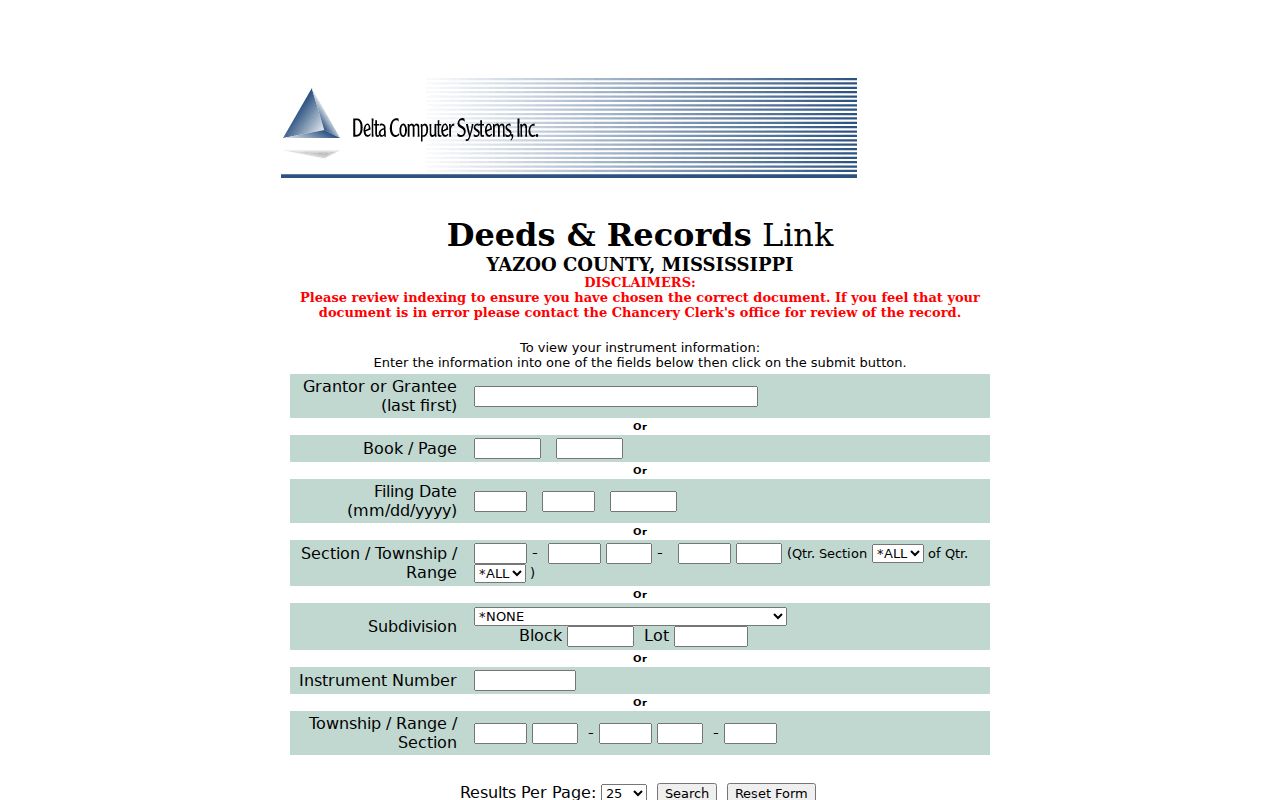
Those extra controls matter. Old deeds often identify land by subdivision or government survey rather than a modern street address, so the land key can be the only way to tie a parcel number to the right instrument.
Walk Yazoo County Owners Backward
Start from a verified current parcel. The Yazoo County Property Link accepts an address, owner, parcel number, PPIN, or section-township-range. Copy its parcel key, situs address, mailing address, owner of record, and legal description. Keep them in separate notes. Situs means the physical location. The mailing address is where the tax bill goes, and it may be elsewhere. Neither one replaces the description that identifies the land in a deed.
- Find the current owner as grantee and identify the newest deed for the same land.
- Open that deed and copy each grantor, filing date, book/page or instrument number, and legal description.
- Search the prior owner as a grantee in an earlier period, using the land key to avoid a same-name match.
- Repeat the link. When online results stop, take the last citation to the physical books or archive microfilm.
- Grantor / grantee
- The person or entity conveying an interest and the person or entity receiving it.
- Chain of title
- The ordered sequence of recorded transfers for the same land.
- Legal description
- The lot, block, subdivision, metes-and-bounds, or survey description that identifies land despite address changes.
Some instruments will not read like a normal sale. A quitclaim deed, executor deed, trustee deed, or court-ordered transfer still belongs in the chain. So preserve every party and each capacity. Note whether the deed conveys all of a tract or only part. A split parcel may send the search into the Map and Plat Book and older descriptions. Only then do the former owners line up.
Probate Breaks Yazoo Owner Names
Death can break a neat grantor-to-grantee sequence. Yazoo County Chancery Court hears estates, and the Chancery Clerk holds the probate files. A will, letters, inventory, heirship proof, court order, or executor deed may explain the break. The next owner of record may have a different surname. The same papers may show several heirs receiving undivided shares. The deed index alone may display only the final instrument.
When the chain jumps without an ordinary sale, request the estate file by decedent name. An approximate year helps narrow the search. Restricted Mississippi vital certificates are not the default route. Probate papers, wills, cemetery records, deeds, and tax rolls can document property succession without touching a protected birth or death certificate. Court access follows court rules, and some estate or guardianship material stays restricted.
Historic Yazoo County Land Clues
MDAH's Yazoo County finding aid spans 1824 through 1981. It describes original records plus courthouse microfilm. Its county tax-roll series covers 1818 through 1902 statewide, with named Yazoo land rolls for 1889 and 1896. The digital Series 1202 begins with combined records in 1823. It identifies 362 items in the 1889 land material. These collections extend a former-owner search well beyond the online deed form.
One unusually candid catalog note marks termite damage in the 1873 Yazoo personal-tax roll. A damaged or incomplete roll deserves checking against adjacent years. It also merits review alongside land rolls, deeds, and census material. Names in a tax record remain clues. They may describe a taxpayer or occupant rather than prove fee title, so the recorded deed remains the stronger link.
Old Yazoo Addresses Can Drift
A fire in May 1904 leveled Yazoo City's business district. The courthouse, though, survived. So the records problem here is subtler than a story about everything burning. Downtown rebuilt on the same footprints. National Register material flags mismatches between tax-assessor and city-directory street numbers. Some businesses even carried one number across several buildings.
Anchor any historic address with an owner, a block, and an adjacent street. Add a legal description before trusting it. The MDAH Town Center property inventory lists street addresses and inventory numbers. It also notes contributing status for buildings it identifies. That can bridge a gap in a house history. It cannot stand in for a deed. For rural parcels, work from section, township, range, and quarter-section. Do that when no street number existed yet.
Limits of Yazoo Ownership History
The online index announces no earliest year of coverage. Treat a no-result search as just that, not proof of where the records stop. Instead, call the Yazoo County Chancery Clerk at 662-746-2661 or visit 211 E. Broadway Street in Yazoo City with the latest known book and page, the names, and a date range. Bring a legal description as well. Ask what sits behind the index. It might be a deed book, a sectional index, an original-entry or patent volume, or a plat book. It could also be a will book, an archived box, or a microfilm roll.
Keep perspective on what each instrument does. Mortgages, releases, substitutions, liens, and lis pendens can explain a gap or a claim. Yet none of them necessarily moves ownership. A lis pendens simply warns that a lawsuit involving the land is pending. Quiet-title, partition, foreclosure, and estate cases may hold the decree linking two recorded owners. For a purchase, a boundary dispute, or an unresolved break in the chain, a Mississippi title professional should read the full record. They should not lean on a name list.
Lawful use. Former-owner research supports house history, estate work, and property due diligence. Never use owner or address records to track, threaten, stalk, or harass a living person.