
Inside Yazoo County Tax Records
Every tax record in the county starts with the annual assessment roll. The Tax Assessor locates real and personal property and classifies it. The same office assigns value and maintains the ownership maps. Collection is a different job. The Tax Collector bills and receives the tax. That office handles delinquent real estate as well. Keeping those roles straight prevents a common error. The assessor explains value and classification. The collector can tell you whether a bill is paid, unpaid, or moving toward a delinquent sale.
| Field | What It Shows | Where |
|---|---|---|
| True or market value | County estimate of full value | Tax Assessor |
| Assessed value | Tax base after the state class ratio | Tax Assessor |
| Classification | Class I owner-occupied residential or another class | Tax Assessor |
| Exemption | Homestead treatment shown for the parcel | Tax Assessor |
| Bill and status | Amount collected or delinquent | Tax Collector |
Treat any summary of sources as a map. It is not a stand-in for the official roll or a receipt. A sale price lives in the transfer itself. It may appear in a recorded deed. But that figure is not the same as true value, assessed value, or the final tax bill. For a fuller walkthrough of those numbers, see the Yazoo County property value guide.
Mississippi Ratios Shape Yazoo Taxes
The Mississippi Department of Revenue appraisal guide lays out the sequence plainly. True value is multiplied by a statutory assessment ratio to yield assessed value. Millage is then applied to that figure. Class I property, which means single-family owner-occupied residential real estate, is assessed at 10 percent. Class II real property sits at 15 percent. Classification matters even when two parcels carry the same market value.
Knowing that statewide formula makes Yazoo County property tax records easier to read. The assessment is a tax figure rather than a private appraisal. The final bill also depends on which levies attach to the parcel. City, school, county, and other taxing boundaries can differ from one street to the next. Compare like parcels. Verify the districts tied to the actual parcel number before drawing conclusions.
- True value
- The assessor’s estimate of full value under Mississippi appraisal rules.
- Assessment ratio
- The percentage assigned by property class.
- Assessed value
- True value multiplied by the applicable ratio.
- Millage
- The levy applied to assessed value to help calculate tax.
Yazoo County Assessment Calendar
Timing drives much of the Yazoo County property tax cycle. The county's published assessor information sets January 1 as the assessment lien date. Homestead applications are due by April 1. The finished roll reaches the Board of Supervisors by the first Monday in July. Equalization begins then, and the roll opens for public inspection.
Objections are heard at the August meeting. The Board must finish equalization by the first Monday in August. It may continue day to day, but it cannot run past the first Monday in September. Anyone contesting an assessment should not sit back and wait for a bill. Inspect the roll during the open period. Contact the Yazoo County Tax Assessor, and keep any records that back up the correction you want.
Calendar key. Review begins in July, while objections belong before the Board of Supervisors during its August equalization work.
Look Up Yazoo County Taxes
The quickest route runs through the Yazoo County Property Link. It accepts an owner name, address, parcel number, section-township-range, or PPIN. Grab the exact parcel key and the assessment fields from the result. Then hand that key to the Tax Collector for the payment history. The county publishes no separate, fully documented bill-search interface. A phone call or a counter visit is the dependable fallback.
- Search Property Link with the street address, owner, parcel number, PPIN, or land description.
- Save the parcel number, classification, owner entry, legal description, and value fields.
- Ask the Tax Collector to match that parcel to the current and prior-year payment status.
- Confirm any delinquency, advertised sale, or receipt directly with the collecting office.
Addresses shift more than parcel keys do, especially on rural land. When an address search fails, try the street name alone. Then fall back on the owner or the section-township-range. The statewide Mississippi tax-forfeited property search covers land that has reached the state system, and it is a separate source from the current county tax roll.
Yazoo Homestead Record Checks
Homestead exemption leaves its own paper trail. Mississippi's homestead guidance requires an eligible owner to apply by April 1. Yazoo County publishes a homestead worksheet along with forms for deleting an exemption and handling an undivided estate. Those forms can ask about purchase details, the previous owner, and the parcel's legal residence status.
Remember that an exemption shapes tax treatment only. It does not prove title. An owner name or residence status may have changed. Check the assessor file and the newest Chancery Clerk deed on separate tracks. A parcel bought late in the prior year deserves extra care. The deed, the roll, and the exemption record can each sit at a different step in the process.
Challenge a Yazoo County Assessment
An assessment challenge in Yazoo County begins with the Tax Assessor, not the Tax Collector. Start with the details, not the value. Check the parcel number, classification, land and improvement figures, and any exemption on the record. Errors there sink many appeals fast. Bring evidence tied to the parcel itself. Photographs of its condition, a survey or plat when dimensions look wrong, a deed if ownership reads stale, and comparable information that speaks to the assessor's valuation all give the office something to act on.
When the informal route fails, the county calendar moves formal objections to the Board of Supervisors during equalization. That cycle runs July through August. Mississippi law allows a further petition after the Board rules. Yazoo County posts no special online appeal portal. Beyond that, confirm the current meeting date and filing instructions with the county, since a prior year's calendar can mislead.
Appeal window. Inspect the July roll and present objections during the Board of Supervisors’ August equalization process.
Delinquent Yazoo Property Tax Records
Unpaid real-property taxes in Yazoo County belong to the Tax Collector, who advertises and runs the annual sale. A delinquent flag deserves a direct check. Payment, advertising, sale, and state disposition are separate stages. One record rarely tells the whole story. Ask for the parcel's status, tax year, amount, and any sale reference. A collector receipt beats a copied web result.
For land in the Secretary of State's tax-forfeited search, treat the state result as a lead. Cross-check the county parcel and the Chancery records next. The state property screen searches by county, address, parcel, PPIN, market-value range, assessed owner, legal description, and location. It is not a list of every currently late Yazoo County account.
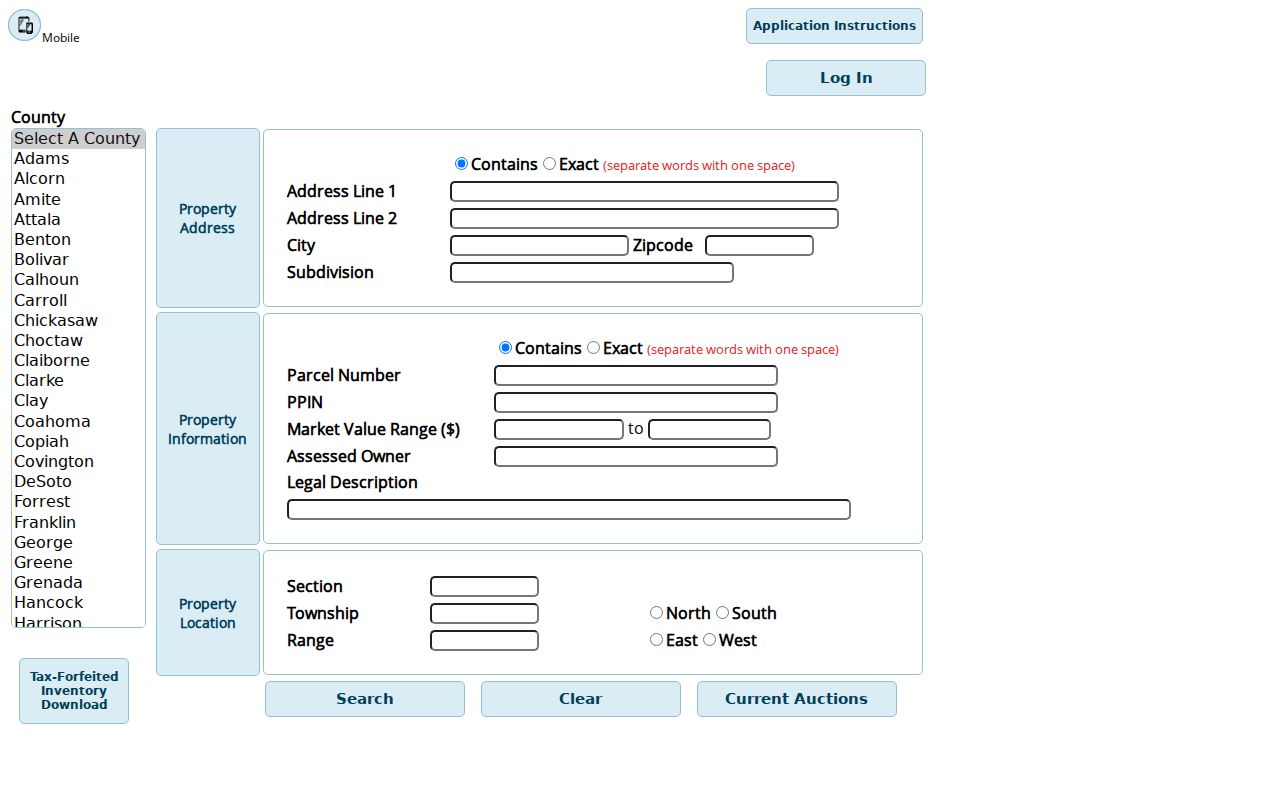
The official state page displays its full filter set. Parcel and legal-description keys can narrow a Yazoo County result, though the state list is not the active county roll.
| Stage | Best record | Office |
|---|---|---|
| Current payment | Tax account or receipt | Tax Collector |
| County delinquency | Delinquent status and sale notice | Tax Collector |
| State-held land | Tax-forfeited property result | Secretary of State |
| Title follow-up | Deed, lien, or court filing | Chancery Clerk |
Request Yazoo Tax Records Offline
Online tools are only one channel. The Yazoo County Tax Assessor sits at 212 E. Broadway St. in Yazoo City, reachable at 662-746-2642. The Tax Collector is at 209 E. Broadway St., with phone 662-746-1583. Call before you go. A certified roll extract, an archived receipt, or a fee quote often takes a live request, since the county's public pages do not state every copy charge or mail procedure.
Older land rolls and tax receipts pass to the Chancery Clerk's custody once they leave active use. Deeper history has another home. The MDAH Yazoo tax and land series holds dated runs reaching back to the nineteenth century, including identified land rolls for 1889 and 1896. That archive can stretch a parcel's tax trail. It cannot replace the current county roll.
Limits of Yazoo Tax Data
A tax roll is an administrative record. It is not a deed, a survey, a private appraisal, or a promise that every fact is current. Ownership on the roll can lag a recent closing. A mapped line helps identify the taxed parcel, but it cannot settle a boundary. The latest recorded deed confirms ownership better. A licensed survey settles disputed lines.
Use Yazoo County property tax records for lawful parcel research, purchase diligence, assessment review, and payment verification. Conflicts deserve a paper trail. If an online result clashes with a receipt, a deed, or facts on the ground, preserve the parcel key and ask the responsible office to correct or explain the field.
The office division is the final quality check. Classification, ownership-map entries, value, and homestead questions belong with the Tax Assessor. Amounts collected, receipts, delinquency, and the annual unpaid-tax sale belong with the Tax Collector. Deeds, liens, plats, and older rolls belong with the Chancery Clerk. Send each disputed fact to its custodian. That beats asking one office to certify another's work.
Keep the tax year with every copied figure. A current roll entry, an older receipt, and a state tax-forfeited result describe different stages, so never merge them without their dates.